Survey response rates have been sliding for decades across phone, mail, online, and government surveys. When a consumer panel goes quiet, most research teams reach for the same fix: raise the incentive. It helps, but it is the most expensive lever available. Research on consumer incentives points to cheaper options. Whether the reward is guaranteed, when it arrives, and what form it takes all change what the same budget buys, and how much the answers are worth once fieldwork finishes In short, how and when you deliver the incentive can materially change what the same budget accomplishes, and consumer research incentives are as much a design decision as a cost decision.
More Money Helps, but It Is Not the Only Lever
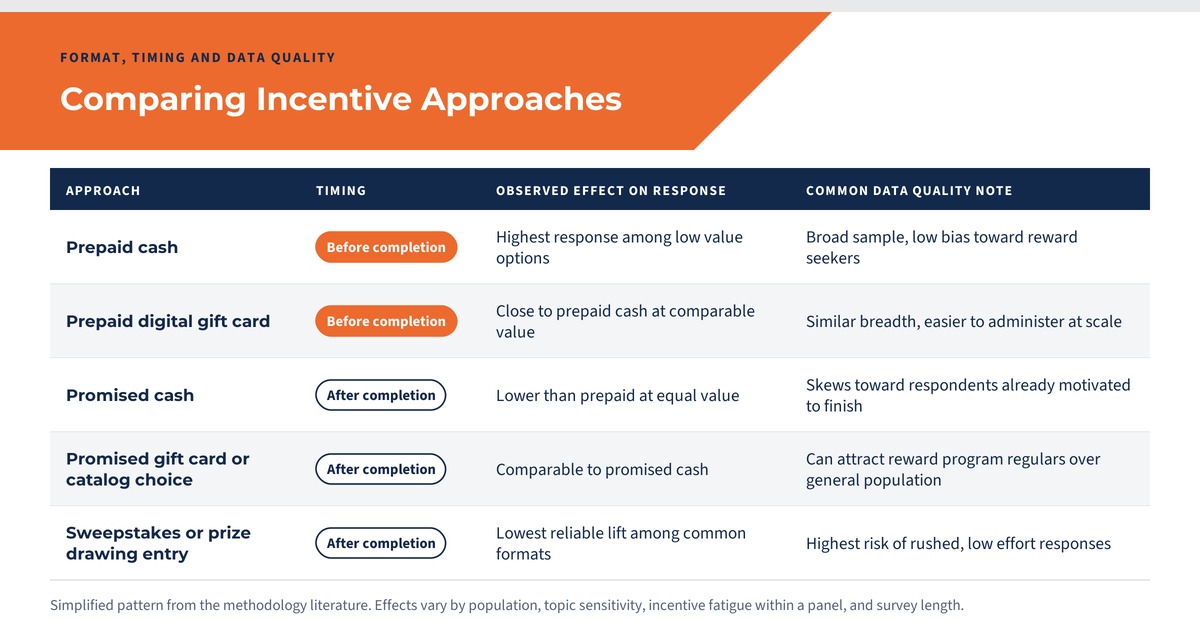
A 2023 PLOS ONE meta-analysis of 46 randomized controlled trials involving 109,648 participants across 14 countries found that incentives increased survey response. Compared with no incentive, money was associated with a 25% higher response rate, vouchers with a 19% increase, and lotteries with a 12% increase. This affirms that money matters, but it is not the whole story.
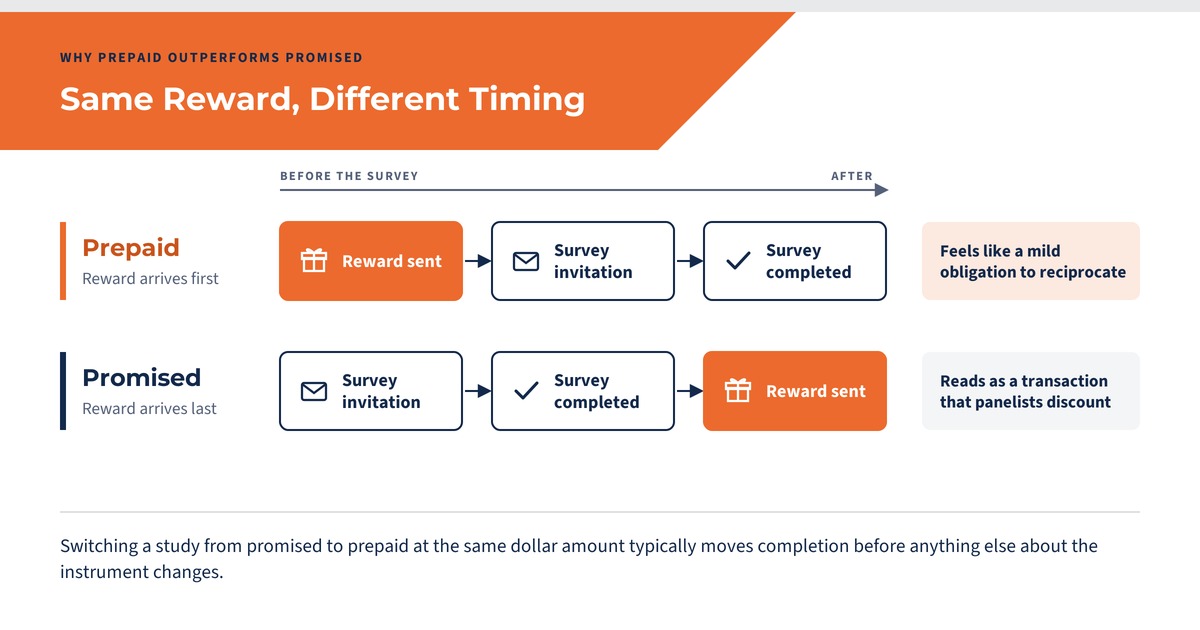
Singer and Ye’s review of survey incentives found that response generally rises as incentive value increases, although not linearly. The same review found that prepaid incentives tend to outperform incentives promised after completion, while lotteries tend to be less effective than prepaid incentives. So what’s the takeaway? A team deciding between a $50 and $100 reward should ask more questions instead of defaulting to whether the extra $50 will purchase more responses. Is the reward guaranteed? When does the participant receive it? How much friction does the recipient experience using the reward? Timing is a lever, and so is reward format. For example, in mail surveys, a small prepaid incentive often outperforms a larger promise one. Each answer is a lever, and most of them cost significantly less than doubling the budget.
Practical Incentive Options for Research Teams
Once a study has settled the amount, timing, and format, the team still has to deliver the incentive without adding friction to fieldwork. Each option carries a different cost:
- Digital gift cards arrive by email or SMS and need no mailing address, which suits online panels
- Prepaid Visa or Mastercard cards give participants spending flexibility when no single brand fits the sample
- Checks and cash suit mail and in-person studies but add handling and reconciliation
- Charitable donations offer an option for participants who’d rather not take money
Giftogram supports consumer incentive rewards across these formats: gift cards from 140,000+ national and local brands, prepaid Visa and Mastercard cards, charitable donations, and cash options, sent individually or in bulk by email or SMS. For online panels, this removes printing, inventory, mailing addresses, and repeated manual sends, and lets a team issue rewards the day a response is recorded. Incentive platforms are especially useful as research scales to include thousands of participants when manual reward sending becomes an administrative drag.
Why Prepaid Incentives Outperform Promised Ones
Prepaid incentives have a long history in research, particularly in mail and other self-administered survey designs. This leverages the prepaid effect. Recipients feel a subtle moral obligation to return the favor by completing the survey after receiving something they perceive as unearned. It is a type of social exchange. The observed result is that a smaller prepaid incentive can outperform a larger reward promised after completion in certain study designs, giving researchers another variable to test before simply raising the face value.
Participant Reward Design Starts With Preference
Participant reward design also has to account for preference. University of Illinois research, Leaving money on the table, found substantial variation in compensation preferences in an online survey. More than twice as many participants chose a one-in-twenty chance of a $100 electronic gift card as a guaranteed electronic gift card with the same expected value, while almost 20% declined financial incentives entirely. This leads to the somewhat irksome conclusion that no single reward format works equally well for everyone, but the upside is that creative study designs can do much more on smaller budgets.
Response Rate Is Not the Same as Data Quality
A higher response rate helps, but it doesn’t guarantee you’ll attract the right respondents or get high-quality responses. AAPOR notes that the relationship between response rates and survey quality is much less straightforward than researchers once assumed. Higher response rates don’t reliably reduce bias, so researchers must evaluate survey quality with more than one headline number. The question of whether survey incentives affect data quality has an uncomfortable answer. Survey incentive design is as much a behavioral and user experience decision as a budget decision. Yes, incentives can change participation, but the evidence does not support a simple rule that cash creates a better sample, gift cards create a worse one, or prize draws automatically produce low-effort answers. Singer and Ye found relatively little evidence that incentives materially changed sample composition.
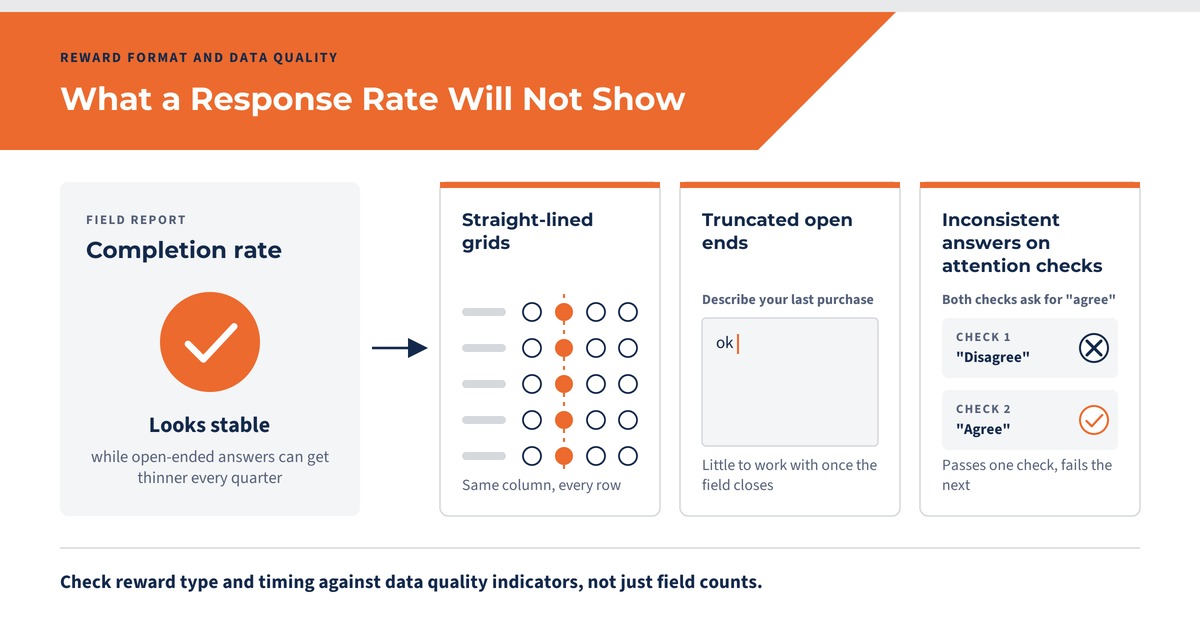
Research teams therefore need to monitor response and quality separately. Speeding, straightlining, missing data, inconsistent answers, fraud signals, and sample balance are different questions from how many invitations converted into completes. The University of Illinois overview of survey and questionnaire methods makes a broader point: questionnaire design, administration, ethics, and bias all shape survey quality. Incentive design is a core part of that system.
What Research Teams Should Test
The best incentive protocol isn’t the most generous. It is the one that produces enough participation from the right population at an acceptable cost. A useful test is to hold the questionnaire constant and vary one incentive feature at a time: amount, prepaid versus promised timing, or reward format. Then compare completion with quality indicators. That turns the incentive budget into something the research team can learn from rather than simply increasing face value whenever response softens.
At larger volumes, the fulfillment layer becomes more important.
Giftogram supports bulk sending, recipient choice, reporting, and integrations, allowing research operations teams to standardize delivery and spend more time on what matters most: survey design. After the study, the focus shifts from the response rate to what this incentive design change did, and whether it was worth the cost.
Frequently Asked Questions
Do larger survey incentives always increase response rates?
No. Higher values can increase responses, but the relationship isn’t linear. Timing and format also affect participation.
Does a higher response rate mean better data quality?
Not necessarily. AAPOR cautions that response rate alone does not reliably distinguish accurate surveys from biased ones. Sample balance, missing data, response patterns, and other quality indicators still matter.
How can researchers at WESpen distribute incentives at scale?
Bulk digital distribution can reduce repeated manual work while keeping fulfillment consistent across large participant groups. Giftogram supports bulk sending, email and SMS delivery, recipient brand choice, reporting, and integrations for research incentive programs.